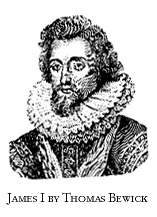
James I and the Doctrine of The Divine Right of Kings
George P. Landow,
Professor of English and Art History, Brown University

 "As the king had no
standing army, and did not even attempt to form one, it would have been wise in
him to avoid any conflict with his people. But such was his indiscretion that,
whlle he altogether neglected the means which alone could make him really
absolute, he constantly put forward, in the most offensive form, claims of which
none of his predecessors had ever dreamed. It was at this time that those
strange theories which . . . which became the badge of the most violent class of
Tories and
high churchmen, first emerged into notice. It was gravely maintained that the
Supreme Being regarded hereditary monarchy, as opposed to other forms of
government, with peculiar favour; that the rule of succession, in order of
primogeniture was a divine institution, . . . ; that no human power. . . could
deprive the legitimate prince of his rights; that his authority was necessarily
always despotic; that the laws by which, in England and in other countries the
prerogative was limited, were to be regarded merely as concessions which the
sovereign had freely made and might at his pleasure resume; and that any treaty
into which a king might enter with his people was merely a declaration of his
present intentions, and not a contract of which the performance conld be
demanded. . . . this theory, though intended to strengthen the foundations of
government, altogether unsettles them." (Thomas Babington Macaulay, A History of England).
"As the king had no
standing army, and did not even attempt to form one, it would have been wise in
him to avoid any conflict with his people. But such was his indiscretion that,
whlle he altogether neglected the means which alone could make him really
absolute, he constantly put forward, in the most offensive form, claims of which
none of his predecessors had ever dreamed. It was at this time that those
strange theories which . . . which became the badge of the most violent class of
Tories and
high churchmen, first emerged into notice. It was gravely maintained that the
Supreme Being regarded hereditary monarchy, as opposed to other forms of
government, with peculiar favour; that the rule of succession, in order of
primogeniture was a divine institution, . . . ; that no human power. . . could
deprive the legitimate prince of his rights; that his authority was necessarily
always despotic; that the laws by which, in England and in other countries the
prerogative was limited, were to be regarded merely as concessions which the
sovereign had freely made and might at his pleasure resume; and that any treaty
into which a king might enter with his people was merely a declaration of his
present intentions, and not a contract of which the performance conld be
demanded. . . . this theory, though intended to strengthen the foundations of
government, altogether unsettles them." (Thomas Babington Macaulay, A History of England).
Content last updated 1996

